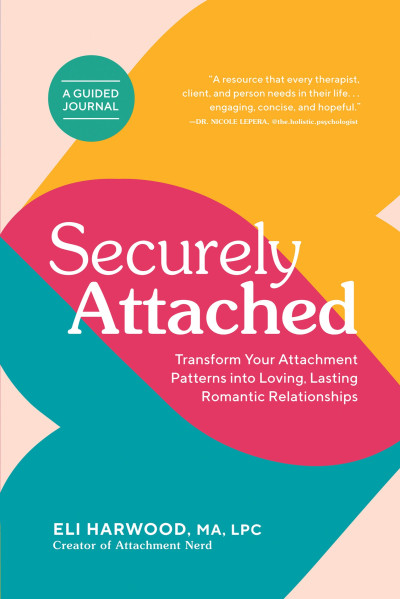
Securely Attached by Eli Harwood: Summary and Key Takeaways
Securely Attached: Transform Your Attachment Patterns into Loving, Lasting Romantic Relationships Eli Harwood, LMFT | 2023 | Workbook / guided journal
Most attachment books explain the theory. This one puts you to work.
Eli Harwood — a therapist who has spent two decades specializing in attachment and built a large following under the name "Attachment Nerd" — wrote this not as a read-through but as a structured process. The premise is direct: understanding where your patterns came from is only half the work. The other half is practice. For readers who've already absorbed the basic concepts and are ready to do something with them, this book provides the architecture for that next step.
The core argument
Insecure attachment is not a fixed character trait. It's learned software — installed by early experiences — that can be updated. Harwood argues that through structured self-reflection, specific relational skills, and accumulated new experiences, anyone can develop what researchers call earned secure attachment: the full capacity for close, stable connection, regardless of how childhood went.
The key phrase is "earned." Harwood is not selling a quick fix or a reframe. She's describing a process that requires real work — and being honest about that is one of the book's genuine strengths.
Key frameworks
The software analogy
"If a human being is a computer, then the attachment instinct is the built-in hard drive; everyone has one. The way your caregivers handle your attachment needs is the software that gets installed on your hard drive."
The important word is software, not hardware. This distinction does real work. The need for connection is universal — hard-wired, not optional. But how you learned to manage that need is variable, shaped by thousands of early interactions with caregivers. Software can be updated. You can't delete it, but you can, as Harwood writes, "eliminate the viruses and add new code to adjust its function." The analogy frames insecure attachment not as damage but as outdated programming — a framing that opens the door to change without requiring you to pathologize yourself first.
Animal metaphors for each attachment strategy
Rather than using clinical labels, Harwood introduces four animals as stand-ins for each attachment pattern:
- Koala (Secure): seeks closeness when distressed, genuinely calmed by connection
- Honey Badger (Anxious/Preoccupied): constantly scanning for abandonment, protests in ways that paradoxically push people away
- Turtle (Avoidant/Dismissive): retracts into the shell when things get emotionally close, inhibits feeling rather than expressing it
- Teddy Bear / Grizzly Bear (Disorganized/Fearful): oscillates between desperate closeness and sudden withdrawal, often unpredictably
These aren't just mnemonic devices. The animals capture the functional logic of each strategy in a way that's recognizable without being clinical or shaming. Seeing yourself as a turtle who learned to protect itself lands differently than being labeled "dismissive avoidant." And being able to say "I'm going into honey badger mode" during a conflict gives both partners a shared language that de-escalates rather than accuses.
The three-part journey: past, present, future
The book's structure mirrors its argument. Three parts, each named as a chapter of a story:
Part I — Where Your Story Began: Processing and making sense of childhood attachment experiences. Who were your caregivers? How did they handle your emotional needs? What did you learn was safe or unsafe to feel? The exercises here are archaeological — digging into what shaped the software before you could choose it.
Part II — Where Your Story Ended Up: Understanding how those early patterns replay in adult relationships. Harwood's vivid phrase: "Whatever is stored in your body from your experiences in your growing up years, gets sloshed out onto the people that you are trying to get close to." This section examines how the templates built in childhood activate in response to adult partners — why conflict triggers things that seem disproportionate, why certain patterns repeat across relationships.
Part III — Where Your Story Is Heading: Learning specific, practical skills for relating with more security. This is where the book earns the "workbook" label — structured exercises for building the eight traits of secure attachment, practicing conflict repair, communicating needs, and building what Harwood calls emotional trustworthiness.
The three-part structure is more than organizational. It embodies the book's argument: you can't skip the past to fix the present, but the past isn't the destination either.
The eight traits of secure attachment
Part III operationalizes "secure" in concrete, behavioral terms. Harwood identifies eight traits that characterize securely attached people: Caring, Receptive, Curious, Accountable, Responsive, Equitable, Honest, Compassionate. Each is a specific, learnable behavior — not a personality type, not something you either have or don't.
The book includes a self-assessment where readers mark their confidence level for each trait. This is one of the most practically useful moments in the book: it converts the abstract goal of "becoming more secure" into specific areas for work. You're not trying to become a different person. You're building specific capacities, one at a time.
Earning security vs. seeking validation
One of Harwood's sharper insights concerns motivation: "When you resolve your early insecurity, you are no longer seeking love to be worthy, but instead looking for relationships that are worthy of what you want."
This reframe is clinically significant. Insecure attachment often involves using relationships to answer a question about one's own worth — which puts enormous pressure on partners and makes it nearly impossible to evaluate relationships clearly. The shift she's describing isn't from insecurity to confidence. It's from seeking proof of worthiness to already knowing it, and choosing accordingly.
What the book does well
The workbook format genuinely earns its name. The exercises move in sequence: reflection (what happened to you) → recognition (how it shows up) → practice (what to do differently). Each step builds on the last. This isn't theory illustrated by exercises; it's theory in service of exercises. The book is designed to be written in, and it shows.
Harwood's tone is warm without being hollow. She writes with clinical precision and personal transparency. She's been through her own attachment work, and it comes through not as self-disclosure but as credibility. The harder material — examining what your caregivers gave you and didn't — is easier to approach because the guide has clearly been there.
Limitations
This is not a first book on attachment. Harwood introduces concepts at a pace that assumes some prior familiarity. Readers who come in without any prior exposure may find the frameworks moving too quickly. If you haven't read something like Attached or spent time with the basic concepts, starting there first will make this book significantly more useful.
The workbook format requires active engagement that many readers don't sustain. Unlike a narrative book you can read through passively, this one stalls if you don't do the writing. The emotional archaeology it asks for — examining caregivers, mapping childhood feelings, writing letters to past selves — takes real effort, and often more emotional bandwidth than a single sitting provides. Many readers report returning to it across months rather than reading it straight through, which is actually fine, but worth knowing going in.
The animal metaphors, while effective, have limits. They work well for accessibility and for reducing shame. They work less well for capturing the internal complexity of each pattern, particularly fearful-avoidant attachment, which the Teddy/Grizzly Bear metaphor somewhat undersells.
Who should read it
Best for: Someone who already understands their attachment pattern and is ready to move from understanding to active change. Especially valuable if you're already in therapy and want structured exercises to work with between sessions, or if you've done the reading and now want a process rather than more information.
Also for: Partners of insecurely attached people who want a structured way to examine their own patterns, not just their partner's.
Not the right fit for: Someone in the earliest stage of figuring out what attachment theory is, or someone who prefers reading about psychology to actively working through it. For those readers, a more narrative book first — then this.
Related: